Skip to content

SSDI lawyers for veterans and SSDI attorney help with your VA claim

Veterans can receive Social Security Disability Insurance (SSDI) and VA disability compensation at the same time, and neither one reduces the other. An SSDI lawyer for veterans handles the Social Security claim, and an attorney who is also VA-accredited can line it up with a TDIU or rating claim, because both cases rest on the same medical and work evidence. SSDI fees are contingency based. Under an SSA fee agreement the fee is the lesser of 25 percent of past-due benefits or 9,200 dollars for favorable decisions issued on or after November 30, 2024.

MilitaryMedicine is an independent matching service, not affiliated with VA, the Social Security Administration or the Department of Defense, and not a law firm. This is general information, not legal advice.

Talk to an attorney who knows both systems

Your request goes to verified VA-accredited attorneys and claims agents in your state. Many attorneys who take veterans' cases also handle Social Security disability, so mention SSDI when you talk.

Sending a request costs veterans nothing and does not create representation.

Four facts to know before you hire an SSDI attorney

Capped fee

Under an SSA fee agreement, the fee is the lesser of 25 percent of past-due benefits or 9,200 dollars, and SSA approves it before it is paid.

Fast track at 100% P&T

A VA rating of 100 percent permanent and total gets your SSDI claim expedited. It does not decide the claim.

No offset

SSDI and VA disability compensation are paid in full side by side. Neither program reduces the other.

Separate representation

VA accreditation does not cover Social Security. Your representative must be appointed at SSA on its own form.

A veteran at a kitchen table sorting medical paperwork into folders before a first claim

SSDI vs VA disability for veterans side by side

The same back injury or PTSD diagnosis can lead to two very different results, because the two agencies ask different questions. This is why a 70 percent VA rating sometimes comes with an SSDI award and a 100 percent rating sometimes comes with an SSDI denial.

Compare SSDI and VA disability compensation
QuestionSSDI (Social Security)VA disability compensation
Who decidesThe Social Security AdministrationThe Department of Veterans Affairs
What is measuredWhether you can do any substantial gainful activity for at least 12 monthsHow much each service-connected condition impairs you, rated 0 to 100 percent
Partial benefitsNo, you are either disabled under SSA rules or notYes, ratings combine into a percentage that sets the monthly amount
Link to serviceNot requiredRequired for each condition
Work historyYou need enough recent Social Security work creditsNot a factor
Representative feeFee agreement cap of 25 percent of back pay or 9,200 dollars, whichever is less20 percent or less of past-due benefits presumed reasonable, over 33 1/3 percent presumed unreasonable, no fee before the initial decision
Who can represent youAttorneys and eligible non-attorney representatives appointed at SSAVA-accredited attorneys, claims agents and VSO representatives

If you want to see what your VA ratings add up to before talking to anyone, the VA combined rating table shows how VA math turns several ratings into one percentage. SSA never uses that number directly, but an attorney will ask for it.

When a veteran should hire an SSDI attorney

Your SSDI application or reconsideration was denied

Most first applications are decided on paper. After a denial you have 60 days from receiving the notice to ask for reconsideration, and again to request a hearing. An attorney reads the denial rationale, finds the missing medical or vocational evidence and files on time.

You have a hearing before an administrative law judge

The hearing is where an attorney earns the fee. They prepare you to testify, question the vocational expert about jobs you supposedly can still do and argue how your limitations fit SSA's rules. The fee cap still applies under a standard fee agreement.

You also have a TDIU or increase claim at VA

Two claims about the same inability to work should tell the same story. One attorney who practices before both agencies can use one set of treating source statements, work history and vocational opinions, and avoid contradictions that the other agency may notice.

You are rated 100% P&T and SSA still says no

A permanent and total rating speeds up processing but does not bind SSA. Denials here usually turn on work credits, the onset date or how SSA reads the VA records. A lawyer can address each reason with the evidence SSA actually weighs.

How the 100% P&T fast track works at Social Security

  1. Say it when you apply

    Tell SSA you are a veteran rated 100% P&T, whether you apply online, by phone or in person. Online, note it in the remarks.

  2. Show the VA letter

    Provide the VA notification letter that shows the permanent and total rating. SSA uses it to flag the file for priority handling.

  3. SSA still applies its rules

    Priority changes the speed, not the standard. You still need work credits and a disability that meets SSA's definition.

  4. Wounded warriors qualify too

    Service members disabled while on active duty on or after October 1, 2001 also get expedited processing, no matter where the disability happened.

How TDIU and SSDI fit together

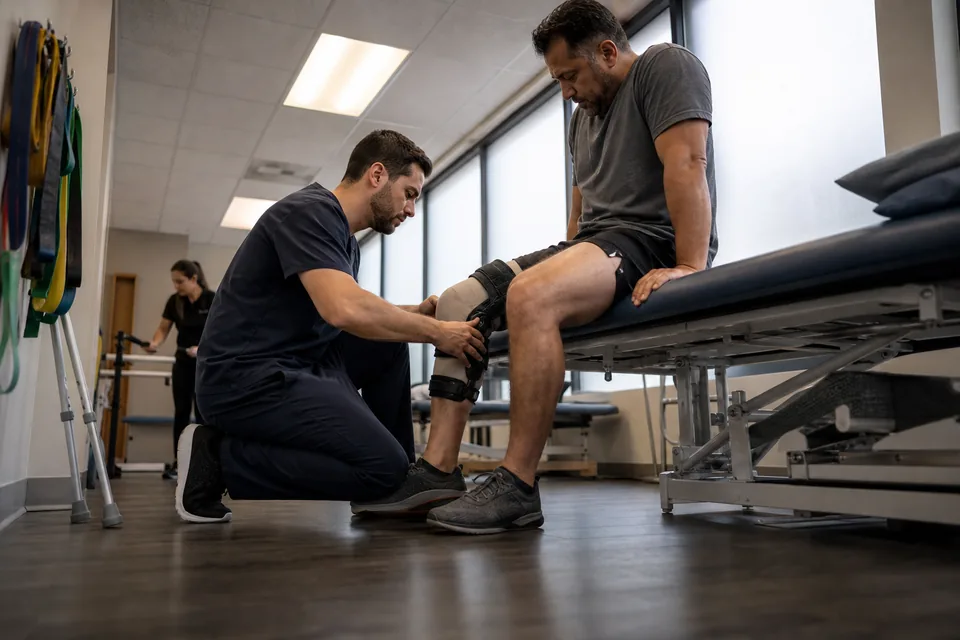
A physical therapist examining the knee of a veteran wearing a brace in a rehabilitation clinic

Total disability based on individual unemployability (TDIU) pays at the 100 percent VA rate when service-connected conditions keep you from holding substantially gainful employment, even if your combined rating is lower. SSDI asks a similar question about work, but it looks at all of your conditions, service connected or not, and adds a work credit test.

Neither agency is bound by the other's decision. Still, an SSDI award with a detailed medical and vocational record often supports a TDIU claim, and a VA examiner's findings about your limits can help at an SSA hearing. When both claims are open, ask whether the same attorney can handle them, or whether a TDIU lawyer and an SSDI attorney will share evidence. Paying two contingency fees on the same work history is not unusual, so read both agreements.

Not sure how to pick between several firms? Our criteria for the best VA disability attorneys apply here too, with one extra question: how many SSDI hearings has this person handled in the past year.

What an SSDI lawyer for veterans costs in practice

SSDI back pay usually runs from your established onset date, after a five month waiting period, to the month of the decision. The fee comes out of that back pay, and SSA withholds and pays it directly to the representative.

Hypothetical SSDI fee examples under a fee agreement
SSDI back pay25 percentFee under the cap
12,000 USD3,000 USD3,000 USD
36,800 USD9,200 USD9,200 USD
60,000 USD15,000 USD9,200 USD
Hypothetical figures for illustration. Out-of-pocket costs such as medical records can be billed separately, and a two-tier agreement or fee petition can produce a different fee. Read your agreement.

VA work is priced differently, as a percentage of VA past-due benefits under 38 CFR 14.636, with no fee allowed before VA decides the initial claim. The VA disability lawyer cost guide walks through that math. If one attorney handles both claims, expect two separate agreements, one filed with SSA and one with VA.

How matching works for veterans with an SSDI claim

  1. Tell us your state and VA stage

    Choose your state, the stage of your VA claim and attorney, claims agent or either. Pick attorney if you want one person for both SSA and VA.

  2. Accredited representatives reply

    We route the request to verified VA-accredited representatives serving your state. Ask in your first call whether they also represent clients before SSA.

  3. You choose and sign directly

    Compare experience and fee terms, then sign appointment and fee forms with the person you pick. A request alone does not protect any SSA or VA deadline.

Questions veterans ask about SSDI lawyers

Can a veteran get SSDI and VA disability at the same time?

Yes. A veteran can receive Social Security Disability Insurance and VA disability compensation at the same time, and neither payment reduces the other. The two programs are separate, so you file two claims, meet two sets of rules and may get two different answers on the same medical evidence.

How much does an SSDI lawyer for veterans cost?

Most SSDI lawyers work on contingency. Under an SSA fee agreement the fee is the lesser of 25 percent of past-due benefits or 9,200 dollars for favorable decisions issued on or after November 30, 2024, and SSA must approve it. If you get no back pay, there is usually no fee, though out-of-pocket costs may apply.

Does a 100% VA rating qualify you for SSDI?

No. A 100 percent VA rating does not automatically qualify you for SSDI. A 100 percent permanent and total rating gets your SSDI claim expedited, but SSA still decides whether you can do substantial gainful activity and whether you have enough work credits. Strong VA evidence often helps, but it is not binding on SSA.

Should I hire a lawyer for SSDI as a veteran?

Hiring a lawyer makes the most sense after a denial, before a hearing with an administrative law judge, or when you also have a TDIU or increase claim at VA. Many veterans file the first SSDI application alone. Because the fee comes from back pay and is capped, cost is rarely the reason to go without help at the hearing stage.

Can my VA claims agent handle my SSDI claim?

Not as your VA claims agent. VA accreditation covers representation before VA only. SSA has its own rules for representatives, so an attorney in good standing or an eligible non-attorney representative must be appointed separately for the SSDI claim. Ask any VA representative whether they also practice before SSA.

Does SSDI reduce VA disability pay?

No. SSDI does not reduce VA disability compensation, and VA compensation does not reduce SSDI. Supplemental Security Income is different because it is a needs-based program, so VA compensation counts as income and can lower or eliminate an SSI payment. Check which Social Security program you are applying for.

Get one attorney for your SSDI and VA claims

If you cannot work and you are fighting two agencies at once, start with an accredited attorney who can see the whole record. Send your state and VA claim stage, then decide whom to call.